

According to Phys.org, the findings were shared at a press conference at the American Astronomical Society’s 247th meeting. The observations have also been accepted for publication in The Astrophysical Journal, while the research paper is currently available on the arXiv preprint server.
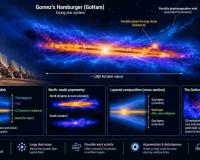
Gomez’s Hamburger is a giant cloud of gas and dust surrounding a young star. The system gets its distinctive name from its unusual appearance, as it is viewed almost directly from the side. Its thick central belt of dust blocks the star’s direct light, while glowing material above and below the belt creates a visual resemblance to a fast-food hamburger.
Using ALMA’s advanced radio telescope array, researchers examined the system’s internal structure and found that solid dust particles and different gases are separated into distinct vertical layers. The heavier dust grains settle close to the central plane of the disk, while lighter gases extend much farther above and below it.
This side-on view offers scientists a rare cross-sectional perspective of a planetary nursery, allowing them to examine the distribution of material that could contribute to planet formation.
Within the system, researchers identified an unusual chemical arc and a dense clump of material that could represent a planet-forming region. In this area, matter may be gathering under the influence of gravity to form a massive planet at a considerable distance from its host star.
However, researchers have not yet confirmed that a fully formed planet exists within the suspected region. The observations instead provide an opportunity to investigate the early stages of planetary formation and examine how material accumulates before a planet takes shape.
Charles Law, an assistant professor at the University of Minnesota and principal investigator on the research, described GoHam as a particularly valuable system for studying planetary development.
“GoHam gives us a rare and clear view of the vertical and radial structure of a very large, nearly edge-on disk,” Law said, as quoted by Phys.org.
“This makes it a benchmark system for testing detailed models of how planets form and evolve in disks. The combination of extreme disk size, strong asymmetries, winds, and potential planet formation makes it the perfect laboratory for understanding how giant planets can form far from their star, and how their presence reshapes the surrounding gas and dust,” he added.
The combination of the system’s enormous disk, distinct vertical layers, strong asymmetries, winds and potential planet-forming region makes it a valuable target for further investigation. Its nearly edge-on orientation allows astronomers to study structures that are difficult to examine from other viewing angles.
Although the suspected planet-forming region remains unconfirmed, the ALMA observations provide detailed evidence of how gas and dust are organised within the disk. The findings offer researchers a rare opportunity to investigate the conditions under which giant planets may begin forming far from their host stars.
About The Author








Comment List